Thursday, 19 January 2023

Some remarks about Still-life painting


My most recent painting, completed on December 30 last year (2022), is a still-life picture showing a large Italian coffee-pot (or, moka [sometimes moca] or caffettiera), a small coffee cup with saucer, and a glass of water. I painted this picture, and chose this subject, as I had not done any painting since the previous summer due to the exceptionally cold and wet winter - and then spring - last year. I simply wanted to get painting again and chose the things closest to hand, the objects necessary to compose a still-life. After completing the painting, I began to think about still-life pictures in general and my own in particular, painted over the decades of my life as a painter.

To begin with, the name 'still-life' is peculiar because the objects in such pictures are never alive (allowing for the occasional appearance of insects or little dogs), nor lively, that is, they are inanimate, they have no life or soul. In a sense, the 'life' the paintings do have as works of art is that given to them by the painter, and to some extent, it is that given life which viewers respond to. But even in some other European languages, still-life has a strange name: in Italian the equivalent term is natura morta, literally, 'dead nature'; in French, nature morte, again, dead nature; in German, das Stilleben, literally, the still-life; in Dutch, Stilleven, still-life, whence the English term. In all of these, including English, the significance is perhaps more that of '[drawn from] inanimate life, in other words, a (usually) careful study 'from the life' as we used to say, imitating 'nature' in the sense of copying something we can see.

Given that the objects in a still-life picture, as varied as they might be, are, as mentioned, inanimate, it is interesting that in a way, the objects portrayed, so to speak, 'come alive' under the gaze and touch of a painter. Good still-life pictures seem to have some kind of 'life' about them and the only source of that life is the work of the painter; the dynamic would seem to be that the painter's observations, his or her analysis of the subject, impart something of the painter's own life into the treatment of the inanimate objects which, in turn, are sufficiently 'lively' to attract and hold the interest of viewers.

Be that as it may, still-life is a type of painting which has its roots in antiquity; the ancient Greeks and Romans enjoyed still-life pictures, as numerous mural paintings and mosaics eloquently testify. With the advent of Byzantine art however, still-life seems to have gone into a decline (in mural painting) as it had no particular function in the religious and sometimes political art of the time. It did eventually make a cautious return as late-medieval art approached the Renaissance, with small still-lifes playing an inconspicuous role in grander religious and occasionally secular work 1. In both cases, still-life subjects are often 'hidden' in decorative dividing panels between larger narrative scenes; sometimes, still-lifes appear by default as it were, for instance, as the saddle of the ass in a Nativity, adding an element of work-a-day realism to the narrative but placed off to one side so as not to distract. It is obvious, to me at least, that the artist I am thinking of (Alessio Baldovinetti, see photo below) relished his opportunity to do something 'from life', a kind of relief from painting the mandatory characters of a religious image.

Slowly however, still-life came into its own, an image of a slice of reality, normally unassuming, mundane reality, devoid of religious and political connotations (at least, superficially). Since at least the mid-twentieth century however, various critics have seen in still-life paintings concepts of status and power, certain Dutch examples from the so-called Golden Age of Netherlandish culture being prime targets. Some of those observations are certainly pertinent in a social history context, although they do of course ignore the extraordinary artistic skill and imagination of the people (artists) who actually made those same images. As 'documents' of a certain tenor of life, of a certain status, they are undeniable - but also undeniable is their status simply as works of art: a characteristic which has outlived both the power and the status of the individuals - not to mention the individuals themselves - who commissioned or bought those pictures (happily, the critics referred to above should now therefore be able to rest easy in their beds! 2).


A Roman still-life of fish, artist unknown; mosaic, second half of 2nd century AD to early 3rd century AD
Palazzo Massimo alle Terme, Rome (Photo: the author)

Note the high realism of the drawing of the fish above, all specific identifiable species; although not a still-life in the usual sense, the 'objects' not arranged on a table for example, clearly it belongs to that branch of artwork. This piece incidentally, demonstrates very well the wonderful capacity of ancient artists to draw what they could see.


The Nativity by Alessio Baldovinetti, detail of his fresco (1460 - 62) in the Chiostro dei Voti of the church of Santissima Annunziata in Florence (Photo: the author)

This detail shows Saint Joseph leaning on a beautiful 'still-life' of a saddle, with two shepherds entering from the right. The fresco is large and the figures are perhaps half life-size; the saddle is a minor detail in the narrative but, nevertheless, Alessio has observed it closely and rendered it accurately. This fact in itself indicates a Renaissance attitude, one in which artists were encouraged to draw, and learn, from Nature. On the left of this painting is a broad panorama of Tuscan countryside, also drawn from life, from nature.


The Adoration of the Shepherds, also known as The Portinari Altarpiece, by Hugo van der Goes, about 1475; oil on wood  
Gallerie degli Uffizi, Florence (Photo: the author)


This exquisite detail, this time from another huge Nativity (or, Adoration of the Shepherds) by the Flemish painter Hugo van der Goes, shows what must be one of the most sublime still-lifes ever painted: the two vases of flowers, one ceramic and the other glass, have a 'background' of a sheaf of wheat; this de facto still-life sits at the base and in the centre of the central panel of this extraordinary triptych. The flowers of course have symbolic meaning, especially the irises. The whole work is astonishing but it is possible to isolate the 'still-life' in the centre foreground and enjoy it for being just that!


The Annunciation by Pietro del Donzello, tempera (and oil?) on wood, 1498
The church of Santo Spirito, Florence (Photo: the author)

This wonderful picture by Donzello is another instance of a vase of irises appearing, front and centre, in an Annunciation; the flowers in this subject always separate the Angel and the Virgin. This painting exemplifies two important developments which occurred during the Renaissance: the first is the obvious and skilful use of perspective;  the other is the gradual insinuation of realistic landscape representations into paintings - seen here in the far distance, beyond the architecture (which itself resembles that of the real space in which we find this painting). Renaissance art, both painting and sculpture, was extremely interested in the mastery of the human figure (although not so for Pietro here, who seems to have preferred an older style) and, in the case of Michelangelo for example, it was the only subject. Slowly at first, but inexorably, landscape began to appear in paintings - and even in some sculpture - until, quite a bit later, it became its own, independent subject; again, the ancient Romans already had landscape paintings on the walls of their houses but, as with many things of this nature, it (landscape painting) disappeared with the development of Byzantine art.


Still-life by Baccio Pontelli and Giuliano da Maiano, intarsia work (inlaid wood), 1473 - 76 (?)
Lo Studiolo di Federico da Montefeltro, Palazzo Ducale, Urbino (Photo: the author)


The walls of this fabulous small study in the palace of Federico da Montefeltro (1422 - 82), Duke of Urbino, are truly awe inspiring; the illusion of reality, albeit created with inlaid wood, is so convincing that one is continually in doubt about what is real and what isn't! In this example, apart from the open door (an illusion, as with everything in the photo) we see a number of objects, including books and some hanging beads; but the most extraordinary object is the so-called mazzocchio, the circular multi-faceted article often seen in perspective drawings of the time. It was a type of headdress (sometimes covered in cloth) worn by fashionable men of the period but is present also in works of art wherein it was a particular favourite of Paolo Uccello 3. He, like others investigating the 'mysteries' of perspective, loved the mazzocchio for the very difficulty of drawing it. It is seen here as a wooden object leaning against what seems to be a shiny surface where we can see its reflection! In any case, a very demanding exercise with pencil and paper, here absolutely amazing in wood; the whole image is of course, a still-life, which, unlike in painting proper at the time, was an acceptable subject for intarsia. Such illusionistic inlay work can be seen in many places in Italy, including in churches (choir stalls and so on).


Funerary monument (completed?) by Luca della Robbia; marble sculpture and glazed ceramic border
The church of Santa Trinita, Florence (Photo: the author)

This photo and the next, a detail of the decorative border surrounding the monument itself, show an example of still-life being, so to say, 'hidden' in peripheral areas (here, literally). The work is typical of the superlative skills of Renaissance artists, including in ceramics, a field Luca and his family specialised in. Although not related to the present topic, the painting visible in the photo is the remains of an earlier fresco, a wonderful work in its own right.
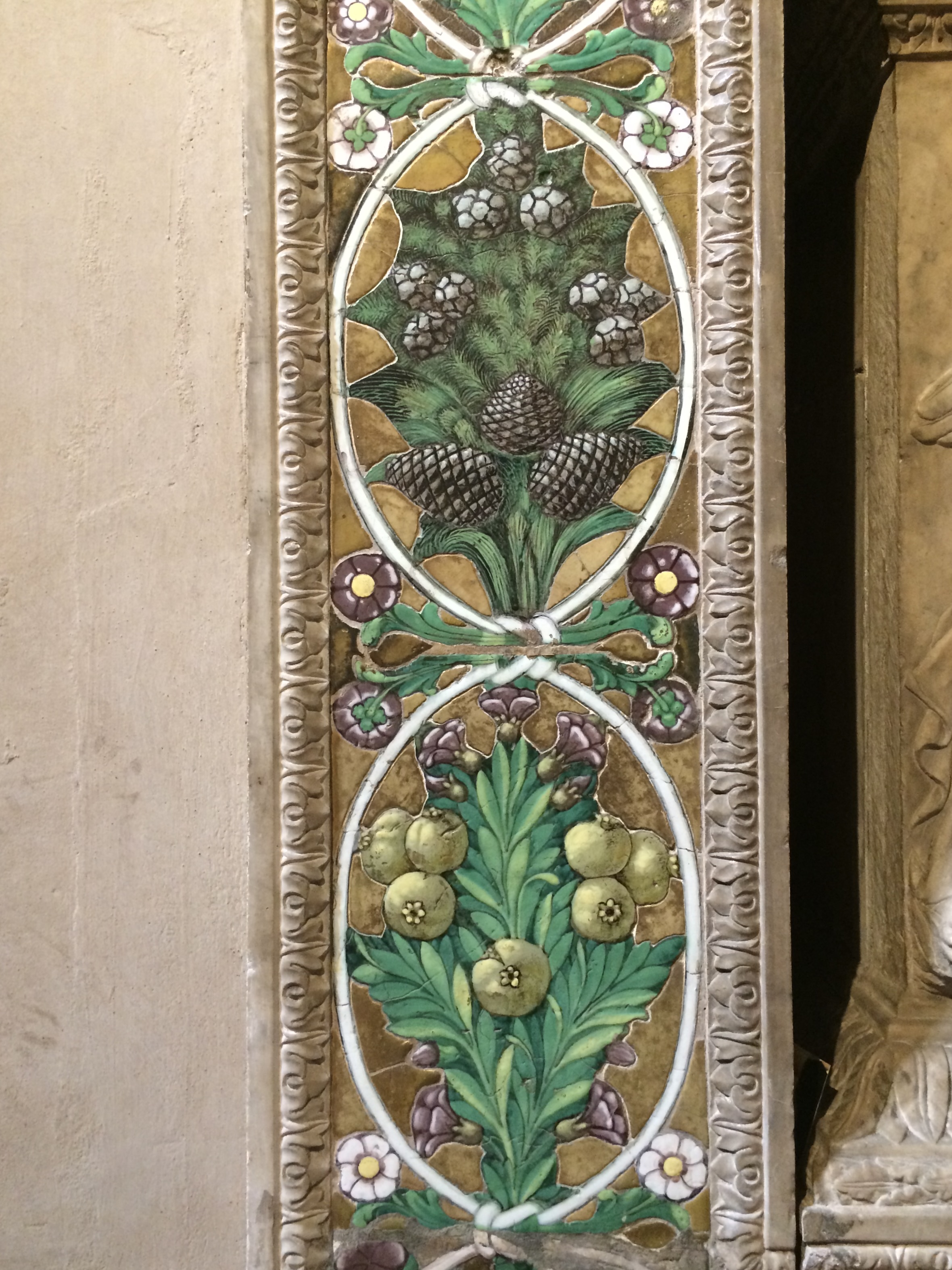

From the photo above, a detail of the ceramic decoration showing plants and flowers: a decorative border composed of a series of still-lifes! (Photo: the author)

Jumping ahead to the Baroque period, still-life by then had established itself as an independent subject, that is to say, it was not merely a kind of anecdotal accompaniment to some more 'serious' theme. The influence of Caravaggio was at this time profound and consequently, many works - including still-lifes - are quite dark; a characteristic which contrasts them with both what existed before and what came later: many Renaissance pictures - not all - are quite light in tone, as are many from, say, Impressionism through to various schools of Modernism. Let's begin then with Ribera (1591 - 1670).


Still-life with Goat's Head by Jusepe de Ribera, oil on canvas, c.1645 - 49
Museo di Capodimonte, Naples (Photo: the author)


A medium-sized picture, in tone very typical of the period - and the place (Naples) - it is a classic example of Ribera's wonderful mastery, not only of his craft, but also of still-life. Ribera enjoyed popular favour with his similarly strong and dark paintings of saints; in this image, the extreme chiaroscuro (Italian, light+dark) of the mature Caravaggio is critical to this powerful treatment of food - if a little gruesome for modern taste. Food was (even in Roman times) and still is a common theme in still-life paintings and another great painter of the period specialised in food and her name is Giovanna Garzoni (1600 - 1670). 


Still-life with Cherries by Giovanna Garzoni, gouache on parchment (?), 1642 - 51(?)
Galleria Palatina, Florence (Image by Sailko via Wikimedia Commons)

Giovanna made many still-life paintings as well as other subjects; her light touch and colours were somewhat at odds with the prevailing preference for strong contrast between light and dark; her chosen media were also unusual as many of her works are done in water-based colours on parchment, as here. As is obvious, she was a master painter.


Still-life with Silver Goblet by Jean Siméon Chardin, oil on canvas, c.1728
St. Louis Art Museum, Missouri, USA (Image: Wikimedia Commons)

Chardin is regarded as one of the great masters of still-life but he also painted - also in pastel - portraits and homely interiors, often with working people at their chores; an interesting choice in France at the time, given that the decadence of the court and nobility was in full swing, so to speak 4. Chardin preferred the ordinary, the homely, the modest, themes he treated with a degree of gravitas normally reserved for more 'formal' subjects. He frequently made use of a darker background against which he contrasted not only his lights, but also his beautiful colours, as seen in the example above. His pictures in pastel are extraordinary.

Still-life paintings, such as the three just looked at, might be regarded as typical, even canonical, of still-life as understood right up to the present: a series of objects, including flowers and food of all sorts, and at times, (usually) dead animals, displayed or arranged on a table, sometimes in great profusion; sometimes, as in more recent work, more sparingly, with only a few objects - maybe only one - arranged more or less in a line, parallel to the picture plane. The definition of space was a given as, in realist terms, the chosen objects had to exist somewhere and naturally, that somewhere was in the fictive 'real' space of the painting, a concept with a history extending at least as far back as the Renaissance. In the Roman example at the beginning of this article, there is no 'space' of the type just described; in a sense, it was simply understood that the fish existed somewhere, but it was apparently unnecessary to specifically indicate that place. The development in early 15th century Italy of certain ideas concerning reality, or nature, meant that a picture, of necessity, had to be coherent in its imitation of the visible world, and that ironically included the invisibility of space itself (notwithstanding Alberti's comment that painters are only concerned with the visible 5). That is, any object (be it a person or anything inanimate) placed in a room for instance, had its space defined with the use of perspective - for the physical structure enclosing the object - and light, which was employed to model form; however, light - through the modulation of colour - was also used to suggest the air, the intangible space in which that object existed. Cubism of course, upset the apple cart so to say, and these earlier canons were rejected almost entirely.


Still-life with Ginger Pot and Aubergines by Paul Cézanne, oil on canvas, 1893-94
The Met, New York (Photo: the author)


With the painting above, we now move into the modern period, the school known as Post-Impressionism, and an example by one of its great masters, Cézanne. Even though all good painting is as much about painting per se as about the putative subject-matter, with the advent of 'modern art' this technical aspect asserted itself as a positive, active part of the visual phenomena of a painting, that is, no longer merely its means. An important break with previous still-life is seen here in the deliberate lack of a horizontal platform, indeed, the bowl of fruit seems about to slide out of the painting. Such divergence from the normal behaviour of gravity, and from the requirements of aesthetic balance, was not only typical of Cézanne, it also led eventually to the fragmentation operated by Picasso and Braque only a few years later.


Still-life with Guitar and Glasses by Juan Gris, mixed media - including collage - on canvas, 1914
The Museum of Modern Art, NY (Photo: the author)


And speaking of Picasso, above is a work by his contemporary and fellow-Spaniard, Juan Gris (1887 - 1927). Gris' works are a kind of intellectual refinement of the raw energy of early Picasso Cubism; interestingly, in the picture above we might notice hints, premonitions, of Mondrian and even Vasarely. But importantly, the canons observed in17th and 18th century still-life were now almost irrelevant and a new aesthetic was established, that of the priority of the painting per se, indeed, even the act of painting per se, that is, in opposition to its age-old function of replication of the visible world, of nature.


Nature morte by Fernand Léger, oil on canvas, 1925 (?)
Yale University Gallery, New Haven, USA (Photo: the author)


As a development of Cubism, the work of Léger (1881 - 1955) is one of the more sophisticated, with clear adherence to certain of the basic principles, but also obvious unique contributions of his own, most notably in his definition of layered space. In this example, there is an almost kinetic quality to the 'objects' depicted, with a sort of subtle to-ing and fro-ing, forwards and backwards, of the various components. A view of both space and form radically different from say, a Chardin.


The Song of Love by Giorgio de Chirico, oil on canvas, 1914
The Museum of Modern Art, NY (Photo: the author)

 
The Italian metaphysical painter de Chirico painted this picture in the same year as the Gris, above, was made; the approach in every way could hardly be more different. Although a metaphysical artist avant la lettre, de Chirico made repeated use of Italy's cultural heritage, reaching back in time as far as classical art and combining it with the most up-to-date technology, such as the steam train in the lower left of the image shown here. Clearly, this picture includes elements of architecture and therefore contains a sort of urban landscape backdrop (not to mention the implied motion of the train), but the overlay of still-life is nevertheless present, causing the disjunctions so beloved of later metaphysical artists.


Natura morta by Giorgio Morandi, oil on canvas, 1946
Galleria Nazionale d'Arte Moderna, Rome (Photo: the author)


Giorgio Morandi (1890 - 1964), a painter from Bologna, also began his professional life as a metaphysical artist but quite soon returned to two main figurative themes, landscape and still-life; he was so original in his treatment of both subjects - in drawings, prints and paintings - that it is difficult to decide to which he contributed more. The example here is a typical Morandi still-life, not only in its handling, in its distribution of the objects, in its colour, but also in the very choice of the objects themselves. Morandi painted over and over again the same small group of objects, humble house-hold objects (which he had painted a sort of neutral colour, that is, the physical objects themselves), arranged and re-arranged a myriad times, resulting in a sometimes sublime stillness, a quiet group of 'friends' interacting with each other, at one and the same time differently - each time - and yet oddly the same. As in this instance, occasionally one or two articles were allowed to exhibit some dash of 'personal' colour, but Morandi's control of tone assured that no-one got out of line, so to speak.


Still-life by Ben Nicholson, mixed media, including oil and gouache, on cardboard, 1945
The Art Gallery of Western Australia, Perth (Photo: the author)


The English artist Ben Nicholson (1894 - 1982), once married to the important sculptor Barbara Hepworth, was a significant figure in pre- and post- WWII British art, at one time hosting Piet Mondrian while on his escape from occupied Europe to the USA. With clear attachment to Cubism and not without some influence from his Dutch guest, and his fellow-countryman Henry Moore, Nicholson brought to still-life an intellectual and aesthetic rigour all his own. After making abstract works, both two-dimensional and low relief, he returned to a highly formal figurative style developed out of his interest in the Constructive idea theory (as opposed to Russian Constructivism). Like Mondrian, he was also a theorist, perhaps most notably in his contributions to, and editing of, the book Circle: International Survey of Constructive Art (1937).

The picture in the Art Gallery at Perth is a fine example of Nicholson's sober, aesthetically highly-refined, formal style; it makes use of several media, favouring clean, precise line combined with areas of subdued colour. Like Mondrian's works, it is a rational statement which nonetheless conveys deep if somewhat private emotion; a twentieth-century, intellectually analytical gaze, so profoundly different from 18th century work for instance.

Finally, I imagine that some readers will question why certain of their favourite still-life paintings are not discussed here, such as those by Van Gogh or Picasso, or the world famous (without a hint of hyperbole) Basket of Fruit by Caravaggio; obviously, it would have been impossible to discuss every great still-life picture in an article of this length, and I felt that, precisely because such paintings are so well-known, it was unnecessary to re-state, yet again, their greatness. Instead, I wanted to illustrate how quite divergent artists had approached this subject-matter and also perhaps bring to your attention some names not so familiar but, in the end, just as wonderful.


Glass Vase with Flowers and a Finch Nest by Jan van Huysum, oil on canvas, c.1720 - 21
Private Collection on loan at the time (2017) to the National Gallery, London (Photo: the author)

I could not finish this article without including a fine example of a flower painting, and a Dutch one at that. Van Huysum (1682 - 1749) apparently got these flowers from his own garden but, wherever he obtained them from, his elegant, subtle mastery of every detail in this still-life is extraordinary.


1 I note that the plural form still-lifes used in this article may disturb some readers who might prefer the form 'still-lives'; dictionaries seem to opt for 'still lifes' (no hyphen) and so that's what is used here, except ... I have added the hyphen as I think the words joined in that way function better as a noun.

2 One of the problems with re-writing history with the aid of a politically focused rear-view mirror is that this often ignores another reality of the present situation: without the good, the bad and the ugly people who paid for particular kinds of artwork, we wouldn't have had it! And those same critics would then have had to find some other art form to get stuck into: perhaps literature or music. In fact, they already do so but, speaking personally, I'd rather have the ruins of a Greek theatre or a Roman temple than the remains of some bark-and-thatch hut any day!

3 The mazzocchio makes several appearances in Uccello's famous tripartite version of The Battle of San Romano (distributed among the National Gallery, London, the Uffizi, Florence and the Louvre, Paris); in the supposed 'middle' section, in Florence, there are at least three combatants wearing mazzocchi!

4 I should explain the obscure pun here, as one of the most well-known images of the French Rococo is that by Fragonard (1732 - 1806) in the Wallace Collection in London, The Swing (1767). This painting, as the name suggests, is of a person on a swing, a young noblewoman, richly dressed, and accompanied by two young men: a picnic pastime of the 'idle rich' of the period. The painting's French title, Les hasards heureux de l'escarpolette (The Happy Accidents of the Swing) alludes to its (typical of the period) voyeuristic implications.

5 Leon Battista Alberti (1404 - 1472) in Della Pittura (On Painting), 1436: see various articles in this blog concerning Alberti.


Friday, 11 November 2022

L.B Alberti: Trattato della Pittura


Leon Battista Alberti self-portrait on a small bronze plaque, c.1435, in the National Gallery of Art, Washington, DC
(Photo: the author)


This article is about a short book written by a Renaissance art theorist and architect called Leon Battista Alberti (1404 -72): Della Pittura, or Trattato della Pittura (About Painting or Treatise on Painting) 1, published first in Italian in 1436 and later in Latin. To begin with, the book is remarkable for the simple fact of having been initially published in the Italian language, as most learned writing was at the time first, or only, published in Latin, the language of the educated classes. Alberti's didactic text is aimed primarily at other artists, at painters specifically, a class whose general lack of familiarity with Latin would have made such a text, had it been published in that language, virtually useless. At the beginning of the book - and at various points during the narrative - Alberti states that he wants what he has to say to be taken as the viewpoint, the understanding, of a painter and not, presumably, since he mentions them several times, as that of a mathematician or scientist (although he himself was both!). He says that he is a painter talking to other painters, and his explication of his material is pragmatic and materialistic rather than, say, mathematically theoretical. 

The book was and is important because, amongst other things, it was the first, since the classical period, to deal with a rational theory of perspective 2. Until the first quarter of the 1400s, the more or less coherent perspective system used in ancient Roman painting had been lost and, in fact, had become redundant as its original illusionistic function was no longer of any use to the subsequent development of Christian art. But for reasons which are still unclear - apart from the growing desire of artists to render actual physical space, as opposed to spiritual space, more accurately - in Florence in the first decades of the 15th century, artists such as Filippo Brunelleschi, Masaccio, Donatello, Luca della Robbia and Uccello came-up with the theory and practice of what we now refer to as mathematical or linear perspective. It would further appear that it was the sculptor-architect Brunelleschi who made the first practical demonstration of a systematic theory of perspective, in about 1416.

The artists just mentioned knew each other and were coincidentally all living and working in Florence; Alberti, actually born in Genoa due to his family's exile from the city on the Arno, returned only in 1434 (see Note 8). Alberti decided to put pen to paper - as he often did - and attempted to explain this new 'science' of perspective to the artists of Florence and Tuscany. Although he claims several times in his treatise to be himself a painter, and indeed to quote from his own painting experience, as far as I am aware, no trace of any painting by him has been found. Notwithstanding this, his work in other fields, notably architecture and theoretical writings (also on architecture), are very well known and documented and we have him to thank for such beautiful buildings as the Tempio Malatestiano in Rimini, the façade of the church of Santa Maria Novella and the Palazzo Rucellai, both in Florence, amongst other structures.


The Basilica of San Francesco (the Tempio Malatestiano) at Rimini: façade (incomplete) by Leon Battista Alberti, c.1451
Note the clear influence of the ancient Roman triumphal arch (Photo: the author)

Like other artists of his generation and those mentioned above, Alberti was responsible for the development and diffusion of the revival of 'classical' knowledge, especially in the three arts of painting, sculpture and architecture (particularly architecture), a revival which began before the Renaissance proper, not only in the arts but also in literature; the 'discovery' of ancient texts (of history, literature, poetry and science), both Greek and Latin, often thanks to Arab copies, sparked and encouraged a 'new' way of seeing the world, a way with the human being as its centre as opposed to the Christian, God-centred paradigm of previous times. In the case of Alberti's book, this new rationalism led to the logical mathematical solution to a particular artistic problem - that of convincingly representing three-dimensional objects on a flat, two-dimensional surface.

Alberti, after opening with a dedication to "Filippo de Ser Brunellesco" in which he mentions not only his (Alberti's) family's exile but also "nostro amicissimo Donato sculptore", "et Nencio et Luca et Masaccio"  3, divides his short book into three parts: the first 'book' (libro primo) is dedicated to explaining how to use perspective itself; the second (libro secondo) deals with the importance and primacy of painting per se and various technical matters pertaining to it; while the third book (libro terzo ed ultimo) deals with the role and nobility of painting. Typically of much literature of the period, many references to classical models and dicta are scattered throughout the three libri, a means of lending authoritative, high-level support to whatever a given writer was trying to say. Della Pittura is in fact shot through with references to classical Greek and Roman artists, both painters and sculptors - as well as authors - whom Alberti quotes or uses as examples of the way things should be done, or the attitudes artists should have to their profession. He several times stresses that the aim of painters should be to bring beauty and grace into the world and thereby make a name for themselves; it should not be to make a lot of money! 

One of the dicta he quotes is that 'man is the measure of all things' (p 35), which he gives mistakenly to Pythagoras (actually Protagoras, d. about 420 BC); in his first book (libro primo) Alberti himself uses the height of an average man, divided by three, as the unit for his demonstration of perspective (p 36). The height of a given human figure in a painting is critical for the position of two important elements in a perspective drawing (or construction): the position of the 'vanishing point' - which he calls the punto centrico - and the position of the 'horizon line'. Both of these are at the same height as his hypothetical standing figure; and he also divides the base line of his perspective construction into units equal to one third (one braccio) the height of his given figure. In this way, Alberti's figure (man) is the measure of all things in a manner actually quite different from that intended in Protagoras' statement (ανθρωποσ μετρον) that the truth or not of things depends on how one sees them. Coincidentally, Protagoras claimed that he could not pronounce on the gods as they could not be observed and, in reference to painting, Alberti said that the painter dealt only with the visible. 4 

In the first book, Alberti sets about explaining how to construct a perspective drawing (the first such attempt since ancient times), and he begins at the very beginning (p 16) by defining a point 5, then a line, then the types of lines, then planes, and so on. Ironically, he sets off at this quite abstract level after having said that, although mathematicians may work in this abstract way, he on the other hand wants to describe these elements in a more down-to-earth language, one that is accessible to painters; on the same page indeed, he says that his words (nostri detti) are to be understood by [are written only for] painters (da solo pictore interpretati). Nevertheless, I feel that beginning in this way is a worthwhile exercise because it is doubtful that many of us have given much thought, if any, to what exactly is the nature of these very basic elements.

On page 24 he begins his discussion of what he refers to as lumi - basically, lights - and the way light and colour influence the way we perceive superficie, or surfaces. Incidentally, it is in this description that Alberti again asserts his status as a painter: "Parliamo come Pictore." ('Let's talk as painters.'). He then goes on to talk about the mixing of colours; in this discussion he points out the critical role of white and black and their power to influence other colours. He then follows with the nature of reflected lights and how they work. At this point he shifts back to more discussion of the elements of perspective construction and specifically mentions the fundamental idea of there being an imaginary pane of glass between the object seen by the painter and the rays of light coming from that object into the painter's eye. This imaginary pane of glass, in practical terms, when painting, is the canvas on which the artist is painting his or her picture. This concept is later (p 36) reframed (pardon the pun) as the famous analogy of the canvas as a window which the painter, so to say, opens onto the world (created in the painting). Again, by the way, just before this last similitude, Alberti says " ... diro quello fo io, quando dipingo.' (' ... I will tell what I do, when I paint.'); once agin he refers to himself as a painter - and how he goes about things! Book One finishes the initial explanation of the basics of the perspective system and Alberti concludes by begging the pardon of his readers for his lack of 'eloquence', saying that being clear and understood are more important than having an ornate style; he encourages the student painter to be diligent in understanding those principles just outlined.

At the beginning of Libro Secondo our author leads into his subject with a discussion of why painting is a worthwhile field of study, and the power of pictures: he claims that pictures have within them a 'divine force' such as to make absent people present, and those long-dead seem almost alive (in historical painting for example). History painting, or istoria, is, according to Alberti (and others), the highest and noblest form of art ("... la istoria è summa opera del pictore, ..." page 94) because of the elevated subject matter (Biblical and historical events, mythology, and so on) and because it requires, normally, so many figures and so many attitudes or poses (to which he devotes quite a bit of time), animals, arms and many other things. But he continues with the 'divine' theme by saying on page 45 that painters can hear their works adorate, adored, and themselves described as another god! (" ... vedra le sue opere essere adorate et sentira sè giudicato un altro iddio."). Painting according to our author was, after all, the font of all the other arts.

After a long digression on the history of painting and how certain important historical figures thought it not unworthy to learn that art, he then introduces the prickly subject of the precedence of painting over sculpture, a debate later known as the Paragone (comparison), a dispute dear to the hearts of later artists such as Michelangelo (for sculpture) and Leonardo da Vinci (for painting). At this point, Alberti claims that nature itself appears to delight in painting, but the important thing really is the repeated reference to nature as the model of all things; another instance of this same idea, ubiquitous in this work, occurs on page 59 where he says that painters should look to nature to see how it composes its forms so that they have grace and beauty: "ad quale imitarla si conviene molto avervi continovo pensieri et cura ..." (' ...  in which to imitate her [nature] it is most beneficial to be thinking continuously and carefully [about nature] ... '); he also in this passage describes nature as a "maravigliosa artefice", that is, a marvellous artisan or artist. 

At this point, our writer reminds his readers to make use of his velo (veil); this item is explained more fully on pages 52 and 53 (and elsewhere) as one of the tools he uses in his own painting. It involved the adoption of an apparently squared (that is, with a grid) piece of transparent cloth or fabric: this was set-up between the painter and the subject or object he or she was painting, the grid squares on the 'veil' acting as a guide to the accurate positioning of viewed objects into a like grid on the canvas or surface to be painted. A similar device can be seen in a very famous woodcut of 1525 by Albrecht Dürer, the Draughtsman Drawing a Reclining Woman. Incidentally, on page 50 of the Trattato, in yet another reference to his own work, Alberti describes how, on occasion, after concentrating on his painting, he is surprised to find that three or four hours had passed: " ... con tanta voluptà ...", that is, with so much pleasure! 6

Another extremely important definition is offered in these same pages and that is of the three 'phases', let's say, of making a painting; the first is circonscriptione (on the same page, also spelt circumscriptione!), which means drawing the outlines of objects (" ... disegniamento del orlo, ..."); the second is compositione, composition; and the third is receptione di lumi, that is the application of colours and, essentially, their modulation so as to represent the effects of light. Throughout these pages, Alberti continues to expound on the use of perspective, and as well, his veil. Here he talks again about istoria, history painting, and interestingly, although he seems to encourage painters to fill this sort of picture with numerous details, he also warns against overdoing it, especially when it amounts to a kind of showing-off: on page 65, "Biasimo io quelli pictori quali, dove vogliono parere copiosi, nulla lassando vacuo, ivi non compositione ma dissoluta confusione disseminano;" ('I criticise those painters who, wanting to appear so inventive, leaving no empty space, spread not composition but great and negligent confusion'). In this regard, it is noteworthy the later development, in 16th century Mannerism, of just this very quality, that is, a form of  horror vacui! The work of Vasari himself can be seen in this light.

On the next page (and later) Alberti introduces yet another fundamental of Renaissance humanistic philosophy, the idea that a person's physical movements reveal the 'movements' of his or her soul (movimento d'animo); as this applies to painting, that the gestures, poses, positions, facial expressions and so on, painted in a picture should also 'reveal' the souls - presumably, the character and spirit and emotions (page 69) - of the actors in the drama. It's worth repeating that, as elsewhere, the author continues to support his thesis with references to classical Greek and Roman writers and especially artists, retelling stories, true or invented, of almost-superhuman painters and sculptors of the classical past. 

On page 68 the concept of the 'interlocutor' is dealt with: by this our author means that somewhere within the istoria there is a figure which acts as a kind of guide to the viewer; whose job it is to direct our attention, either by looks or gestures, to the main part of the action, to the subject proper of the image. In fact, this is taken quite literally on occasions, with, in a religious picture for example, a standing saint actually pointing at the Madonna! A little later, the idea of 'contrapposto' is introduced, especially as a consequence of the weight of the head: according to Alberti, the head is one of the heaviest parts of the body and its movements or positions necessitate a corresponding complementary balancing movement of other parts of the body (see the article on 'Contrapposto and Michelangelo' in this blog).

Still in libro secondo, Alberti now (page 77) posits the use of the mirror, a recommendation also, later, from Leonardo da Vinci: the use of the mirror is as a sort of 'automatic corrector', so to speak: this involves the painter looking at his or her painting as reflected in a mirror because any 'defect' will be instantly obvious (a similar effect may be had by turning one's picture upside down: again, errors, if that they be, become painfully clear)! With this suggestion, our author now moves on to warn against the use of white in representing the highlights on a given surface: he points out that pure white is the brightest and 'whitest' colour a painter has at his or her disposal and that, consequently, painters need to be careful when painting the lightest parts in their pictures. This is a common problem for student painters who often have, as it were, 'nowhere to go' after they have mistakenly used pure white for an area which later turned out not to be the brightest one in their painting.

Finally, in the second book, we come to another famous piece of advice from Alberti. This concerns his disapproval of the use of actual gold - gold leaf - in painting, a custom with a long history, particularly in late-medieval Italian altar-pieces. Alberti's opinion is that the skilful master should be able to imitate the appearance of gold as, in fact, we are dealing with a painted reality and actual gold is a physically real metal; in effect, it is almost a contradiction to introduce into a painted illusion, something which is actually a part of day-to-day physical reality (a point of view not shared by many artists working in the mid-twentieth century!).

We have now arrived at the third and final libro at which point Alberti describes the job of a painter and the aim of painting: "Dico l'uficio del pictore essere così: ...", followed by: "La fine della pictura: ...". The job of the painter is described rather prosaically as the maker of pictures as most people would understand them to be; the function of painting is to represent grace, and (bring) well-being and praise (lode) to the artisan, which are much more important than riches. Here we meet again Alberti's philosophical position, that while it is appropriate and even necessary for the painter to seek praise and a comfortable life from his or her work, wanting to be rich, as a priority, is not appropriate. It is not clear to me exactly why he takes this position but I assume it is because he sees the activity of the painter as a 'noble' one, one that should be pursued, yes, for fame, but not for money per se. The acquisition of fame and praise however is, it seems, a given for Alberti.


The so-called Sacello del Santo Sepolcro designed by Alberti as a tomb for Giovanni di Paolo Rucellai, dated 1467; 
polychrome marble (Photo: the author)


In the following pages, Alberti discusses another of his well-known points of view, the notion that painters should become the friends and intimates of erudite scholars and poets 7. As these are educated people and familiar with the ancient Greek and Roman poets and philosophers, painters can benefit not only from their knowledge, but also from their advice in composing their pictures, their istorie. This leads to the opinion that often, educated rich people will support artists of good character (modesto et buono) rather than those who may actually be somewhat better painters but not of such good character (the experience of the present writer happens unfortunately not to coincide with this happy observation!). But the more serious point is that Alberti, like Vasari writing more than a hundred years later, sees the social position of the artist improving from that of a (mere) artisan to one who is on the same level as those who practise the liberal arts (l'arti liberali): poets, historians, philosophers. To describe these people he uses the word 'docto', a Latin word - like many in his Italian version of this book - (modern Italian dotto), meaning 'highly educated' as well as 'teacher'. Alberti in other words, wants the painter, the artist, to move up the social scale, to be seen as someone who works at least as much with his or her mind as with their hands. As usual, at this point, various examples from antiquity are brought forward to enhance and prove his position.

In the next pages, Alberti discusses three more important ideas: the importance of beauty over accuracy, which concept involves the second idea, that of choosing the best parts from nature, and finally prestezza, another concept of great import for Vasari. The first idea is, in my opinion, as significant today as it was when published in 1436; many aspiring painters, even today, believe that the most minute and painstaking accuracy in their representations is the desired object, and the mark of a highly successful work of art (see also page 96). At the same time that Alberti was warning painters about this pitfall, one of the fellow-artists he mentions in his dedication, the sculptor Donatello, was claiming that the 'unfinished', especially in works to be seen from a distance, was far preferable to the highly-finished, highly-polished work of his contemporaries. In the 19th and 20th centuries of course, the unfinished, the roughly-done of certain styles became not only acceptable but positively desirable!

The second idea, that of choosing the best parts of nature, might seem to contradict what he had been saying up to now, namely, that painters should look to nature as their guide and model, a point he reiterated several times. At the end of his book, he now more specifically counsels artists still to look to nature, but also to be selective. Alberti quotes the example of Zeuxis, a Greek painter of the 5th century BC, who, having to paint a picture which was to be placed in a temple, and realising that no one woman could have all the most desirable qualities ("... pensava, non potere in un solo corpo trovare quante bellezze elli ricercava, ..."), selected the five most beautiful women and from each of them took one or more features as the models for his painting. We should keep in mind that Alberti is not talking about portraits for instance, but rather those history stories (istorie) which he regards so highly; painters use models (nature) of course but, for the principal figures in a large history painting, the painter should be careful to, in effect, combine the best features from those available and not simply use whatever is presented.

The third idea, prestezza, signifies speed; painters, as admonished also by Vasari and famously practised by him, should be able to work at a reasonable speed, by which I understand both Alberti and Vasari to mean that artists should not be lazy about getting their work done, but should be diligent in completing their commissions in a timely manner. Alberti then moves on to an argument which would still have pertinence today, and that is the relative value of copying the work of other painters; Alberti disapproves of this in principle but says that if he had to copy something, he would rather copy a mediocre sculpture than a good painting. He says this is because, from a good painting you learn simply to copy, or imitate, what's already there, whereas, from a sculpture, at least you  have to study the lumi, the lights: that is, to model the forms in light and shade, something which has already been done for you if you copy a painting. He then seems to say that sculpture has the advantage of dealing directly with the physical modelling of (human) forms whereas, on the other hand, for the painter, this modelling of forms is a more difficult thing to achieve.

From here, Alberti makes what is to my mind, an extremely important and insightful observation about making any art, but about painting in particular: that the artist must have in his or her mind a very clear idea of what they want to do prior to beginning the work. This is of utmost importance partly because, as he says: "chè certo più sarà sicuro emendare li errori colla mente, che raderli dalla pictura." ('Because it will definitely be safer [easier] to correct the errors with the mind, than remove them from the painting'). He then remarks that the less confident artisan (artefice) - actually he says lazy (pigro) - will be even less confident if he hasn't made everything clear in his mind before he starts his work. Again, this is still a problem for many young and amateur painters, especially when their training is not up to the task to begin with. Alberti however, doesn't neglect to mention that each artist has his or her own natural gifts and that these should be cultivated with continual diligence; it is not therefore necessary that we all paint istorie: "et diede la natura ad ciascuno igegnio sue proprie dote, ..." (page 95). Finally, he warns that we should nevertheless continue to push ourselves ever forward, and not be content with those particular gifts, whatever they may be.

Our generous author brings his work to conclusion with a discussion of the merits of listening to, indeed seeking, the opinions of others, first of all friends and other artisans, but also the unschooled; all opinions should be heard but "... creda ai più periti." ('believe the most expert.'). On the second last page, Alberti asks his supposed readers - that is to say, other painters - that, if they have enjoyed his work, his book, they should show their appreciation by including his portrait in one of their own paintings: an extraordinary request but, at the same time, a charming and pertinent one: " ... solo questo domando in premio delle mie fatiche, che nelle sue istorie dipingano il viso mio ...". 8 

What is the value of this famous and, in terms of art history, momentous work? First of all, Alberti's, as they say nowadays, 'ground-breaking' dissemination of the new science of perspective construction, and importantly, this in a form and style which could be understood by his main audience, that is, his fellow painters. It is noteworthy that in an age when personal (and community) ego was alive and well, Alberti is at pains to claim for himself the generally accepted lower status of artisan, or simple painter, and further to admit that this is no eloquent treatise such as others might write, even if, in fact, he was an erudite scholar, and an accomplished writer of Latin! Almost equal with this enormous contribution is his introduction of several concepts which were important and influential during his own historical period, the Renaissance, and some of which, in addition, are still important to both artists and art historians today.

Apart from this book and another for which he is at least as equally well-known, De re aedificatoria or L'arte di costruire, (c. 1452, Concerning Building), his remaining structures have an almost modern, spare clarity and elegance about them. As an architect, he was obviously influenced by Roman buildings, such as at Rimini with the Tempio Malatestiano and, to take a possibly less well-known example, his Sacello del Santo Sepolcro (in the Cappella Rucellai, also by him) at the Florentine ex-church of San Pancrazio, now a museum (the entrance - very classical - to the Cappella today functions as the entrance to the museum).


* A note on the language of Alberti. Our writer was a learned man despite his protestations of being simply a painter: he was a noted scholar of Latin and certain of his other written works were published first in that language and not in Italian. Until recently, it was, I suppose, assumed that he first published our book in Latin as well, but more recent scholarship tends to the view that it was published first in Italian and only subsequently in Latin. Be that as it may, Alberti's 'Italian' is in fact, as with other contemporary writers, a kind of blend of Latin and the emerging Italian language: as already noted, the Latin word docto for the modern Italian dotto. Other examples of at least strong Latin influence are pictore and pictura for the Italian pittore and pittura; et (and) for e; extimare (aestimare) for stimare; inventione (invention) for invenzione. And we can add to this examples of the developing Italian at that time, such as his spelling of several words with an 'h' which in modern Italian are not so spelled, for example, chose (a hard 'k' sound: 'things') for the modern cose (still with the hard 'k' sound); huomini (men) for the modern uomini; hanimali for animali; angholi (angles) for angoli. Other spelling differences are the use of 'j' in place of 'i', for instance conlinearij, radij and officij. Quite often the same word will be spelled in two ways; philosofi (Greek 'ph') and filosofi, modern Italian; uficio and officio. Although these differences - which have little or no bearing on an English translation - are usually 'ironed out', so to speak, in modern Italian editions of Della Pittura, they are nevertheless extremely interesting for those interested in the development of languages. Incidentally, nowhere does the equivalent of our word 'artist' appear (in Italian, artista): the people he is speaking to are called artisans (artefici) or, most often, painter (pictori or dipintori); 'artist' came later. The translations in the present article are mine and are sometimes, because of Alberti's writing style, more the sense than transliterations; in any case, there are, even amongst Italian historians, some questions as to the exact meaning of some of his statements. 


1 L. B. Alberti Il trattato della pittura e i cinque ordini architettonici, with Prefazione by G. Papini, published by R. Carabba, Lanciano 1913 (2nd edition 2011)

2 Others followed: for instance, the Libretto sui cinque solidi regolari and La prospettiva nella pittura, both by Piero della Francesca, and the Summa di aritmetica, ecc (1494) by Luca Pacioli (followed in 1509 by his La divina proporzione).

3 " ... our great friend Donato [Donatello], sculptor ...", "and Nencio [Lorenzo Ghiberti] and Luca [della Robbia] and Masaccio".

4 "Delle chose quali non possiamo vedere, niuno nega nulla apartenersene al pictore: solo studia il pictore fingiere, quello si vede." (p 16)

5  p.16 "... dobbiamo sapere, il punto essere segnio, quale non si possa dividere in parte." ('... we must know [understand] the point to be a sign which cannot be divided.')

6 This is an extremely interesting statement as it may explain why we have no identified paintings by Alberti. These few lines begin with his saying, that when he is feeling a bit lazy in relation to his other more important jobs ("- quando dall'altre mie maggiori faccende ..."), he turns his hand to painting - something which occurs often - and it is in such situations that he finds that he has passed, very happily, three or four hours. This is not how one might expect a 'professional' painter to describe his painting activity; it is not a pastime, it's a job, and although professional artists obviously gain much pleasure from their work, it is not something they do, so to speak, between times. 

7 Page 86-87: "Pertanto consiglio, ciascuno pictore molto si faccia familiare ad i poeti, rhetorici et ad li altri simili dotti di lettera, sia che costoro doneranno nuove inventione o certo ajuteranno ad bello componere sua storia, per quali certo adquisteranno in sua pictura molte lode et nome." The last phrase seems to suggest that the poets, philosophers and so on will also gain praise and fame by having their ideas depicted in (your) paintings!

8 In fact, it is thought that his portrait does appear, as painted (some eight or so years earlier than the publication of Della Pittura) by the much admired Masaccio, in the Brancacci Chapel, in Florence; extremely interesting if true, as Alberti's first appearance in Florence was not until until 1434 - that is, after Masaccio had painted the putative portrait! And this return occurred more or less by chance because, as a member of the Curia, Alberti accompanied Pope Eugenio IV on his trip to Florence in that year. If indeed Masaccio has included a portrait of Alberti in a fresco painted around 1428, how and when did they meet?


Sunday, 9 October 2022

Two Trecento Works *


Walking into the first rooms of the Uffizi galleries, which are arranged chronologically, one of the earliest works one meets - apart from some classical sculpture in the corridors - is a wonderful polyptych known as the Saint Cecilia Altarpiece; since we don't know who actually painted this picture, the anonymous artist is known as the 'Saint Cecilia Master' (d.1330 circa). This is not so unusual as many works of the past were unsigned; often, to remedy this problem of authorship, incorrect names, later shown to have been such, have been attached to such pieces. Indeed, important scholars of the 19th and 20th centuries (Cavalcaselle, Morelli, Berenson, Longhi, Zeri, etc.) have occupied themselves with attempting to discover the real names of these anonymous masters, either through exhaustive research of contemporary documents or through connoisseurship, which leans heavily on stylistic analysis; in any case, the two methods are obviously interdependent. In the case of the Saint Cecilia Master, although several names have been suggested, he is still known by that, so to speak, nom de plume.


Scenes from the Life of Saint Cecilia, detail from the Saint Cecilia Altarpiece, c. 1300 by the Saint Cecilia Master, 
 tempera on panel.  Gallerie degli Uffizi, Florence (Photo: the author)

Above is a photo of the left part of this polyptych which actually consists of a large central panel, showing an enthroned Madonna, and eight small panels, four on either side of the central one. The reason we are looking at these smaller scenes in particular is because of their space, or to put it another way, their architecture; and it is because of his description of architecture that this master has been credited with four of the (very large) scenes from the Life of Saint Francis fresco cycle in the upper church of the Basilica of Saint Francis in Assisi: the very first scene and the final three (in narrative order) are thought by some scholars to have been painted, not by Giotto, but by the Saint Cecilia Master.

Although the figures in these little stories, and the splendid ones in the frescos at Assisi, are beautiful in themselves and help, in the latter case - because of their particular qualities - to distinguish the Saint Cecilia Master's work from that of Giotto, it is his representation of architecture - and therefore space - that is so interesting. In other articles, I have focussed on these two formal elements in relation to the oeuvre of several artists, most recently in a discussion of the work of Giotto at Assisi, and we have seen that, in the case of Giotto, important advances were made in the 'realistic' description of buildings and other structures. The Saint Cecilia Master would seem to have been at a similar stage of development as Giotto in this aspect, if not in fact further ahead. Let's look in detail at his work in the Saint Cecilia Altarpiece.

In the first image (above), which is of the two panels on the extreme left side of the altarpiece, what we see are two scenes, or stories, from the life of the Saint. Both episodes are set within a highly articulated architectural space, each with an apparently central 'vanishing point' 1. The artist's interest in 'setting the scene' has focused on his wonderful architectural inventions and his understanding of the way things really look from a given single point of view. In the top picture, with its marvellously contrived tri-partite, heavy wooden ceiling, its receding walls and floor, we are presented with a visually convincing description of a plausible space; like-wise the lower story. In all four stories, the artist has broken with medieval tradition and shown his protagonists in an appropriate scale relative to the size of his buildings. But there are problems!

On closer inspection of the top painting, we see that the wedding-feast table is tilted at a very strange angle and is completely at odds - also in its shape - with the wonderfully rendered space in which it sits. Unless we are to assume that this anonymous master was in fact a precursor of Cézanne, in his tilting forward of such table-tops so as to be almost parallel with the picture plane, it would appear that something is very wrong!  It is a contradiction that we are observing a 'real' event in a 'real' space in which however, a misshapen table is tipping over!

Even more oddly, the painter has drawn the legs of that same table in a way which is generally coherent with the main perspective scheme; but, in relation to the table-top, he seems to have ignored all his marvellous observations and again reverted to a medieval tradition, that of showing tables in such a way that what was on them could be seen by viewers of those works, no matter how illogical that might be. Accepting this lapsus, on the left of this banqueting room there is a doorway - with its own independent vanishing point (see the lintel) - leading us out of that space and into another, implied by the opening in the wall, and by the servant stepping through it; although he is already passing through the doorway, his visible foot is in the same floor space as the waiter in green attending to the table: logically, this is impossible because the size of the table, and the position of the waiter's feet, suggest a certain distance from the doorway. And speaking of feet, despite this confusion, the painter has arranged his standing figures, on the left and right sides, or rather their feet, in such a way that they contribute to the illusion of perspective recession!

These incompatible details 'argue' with the space he is attempting to get us to understand and be psychologically convinced by; psychologically because, in fact, the 'vanishing point' as such is really several and, with the use of a ruler, it becomes obvious that the 'perspective' is intuitive, not mathematical. It seems that each separate compartment of the ceiling has its own vanishing point, although several of the lines tend to converge at the head of the Saint sitting at the table. Although the lines, especially of the elaborate ceiling, appear to converge more or less in the centre of the composition ... they don't!

Similarly, the space of the lower picture is beautifully contrived to convince us that we are looking into a 'real' environment, made more convincing by the figure, and angel, entering through a doorway, and by the use of light and shade to 'substantiate' the forms of the architecture. Tracing the directions of the main receding lines - the orthogonals - we see just how 'approximate' were the painter's judgements; without the later formulation of mathematical or linear perspective - at the beginning of the 15th century - late-medieval artists, those who cared to study what was in front of them rather than repeat traditional schemes, relied on observation and their experienced judgement to represent what they could see. As in this case, and with the curiosity required, some were certainly able to reach convincing results. 


Scenes from the Life of Saint Cecilia, detail from the Saint Cecilia Altarpiece, Uffizi (Photo: the author)


The photo above shows the other two panels on the left side of the Saint Cecilia Altarpiece, again with the stories set within plausibly 'realistic' architectural spaces. The top scene takes place in the matrimonial bedroom of the Saint, a large room also with an impressive tri-partite ceiling, this time with two lateral vaulted arches - the central supporting corbels of which actually partially conceal those vaults. Because it is a bedroom of the period, it is screened-off from the rest of the room by a curtain, at present open so that we can observe what's going on; this curtain helps to further define the space, increasing the illusion of reality. The two figures of the Saint and her new husband are also of the appropriate scale. Apart from the arched vaults, there is no indication of the historical period of the Saint (2nd to 3rd century AD) and the remaining architecture and the clothing are of the period of the altarpiece itself, that is, late medieval.

What is also remarkable about our master's images is his control of light. His careful architectural constructions are forcefully augmented by his use of colour and light, and by the consequent variation of tones; the direction of the light however, the light source, is not consistent and seems not to have been a major concern, except perhaps for the figures; the architectural light is both descriptive and decorative, not especially 'realistic'. This can give a kind of 'story-book' quality to such pictures but, if we look at the lower panel above, we see that again, the Saint Cecilia Master has used colour and light exquisitely in this episode, Cecilia instructing her husband and brother-in-law (in Christian teachings). The light falls on the two seated men behind whom is the recurring pink of the suspended wall curtain, modelling the shape of the space; behind that, the walls are quite dark, as is the standing figure of the Saint herself (her halo has lost its sheen). This combination provides the scene with a convincing deep space aided in turn by the two golden columns supporting the upper verandah of what looks to be a courtyard. While the scene of the room above is all bright light and even colour, the one below is dramatised by strong contrast.

To finish with this great painter, we might remark some other of his peculiarities: the small hands and feet; the elongated bodies; the importance of gesture in his narratives and his wonderful ability to establish dialogue between the actors, particularly in the two right-hand panels; the absence of cast shadows - especially noticeable because of the importance given to light and shade in the architecture; the depiction of the clothing and headdress of the period, especially that of the men; the correct scale of the figures in relation to the buildings.


The Lamentation over the Dead Christ, c. 1360-65 by Giottino (Giotto di Stefano), tempera on panel.  
Gallerie degli Uffizi, Florence  (Photo: the author) 

The photo above is of a smallish panel painted by a follower of Giotto known as Giottino, about whom very little is known. From my point of view, Giottino is a prime example of the sort of artist who, had he painted only one picture - of this quality - in his life, would still be regarded, as a consequence of that one picture, as an essential master! The work is a sublime masterpiece, if for no other reason, because of its depiction of the desperate tragic melancholy of the figure of Mary Magdalen, in the lower right corner.

Detail from The Lamentation over the Dead Christ by Giottino showing Mary Magdalen. 
Uffizi (Photo: the author)

To appreciate works such as this, depicting one of the most deeply human and important episodes in the Passion of Christ, it is not necessary to be a Christian of any sort, nor even a Westerner; in fact, even without knowing the history of the event or of the iconography, it is surely enough to look at the complete desolation on the face of the Magdalen to be aware that a most awful, tragic event had taken place - at least for her. Notice the blushed cheeks of her face, red from long weeping, her hand raised to support her head, isolating her physically (and psychologically) from both the other participants, and from the sight of the man she loved, still with the wounds of the Crown of Thorns clearly visible on His forehead. This deep psychological penetration of the lonely anguish of Magdalen makes of Giottino - in my opinion - something of a forerunner of certain artists of the first half of the 20th century. In formal terms, as noted with other figures and artists, the figure of Mary Magdalen forms a triangle which fits, in this case, neatly into the corner of the image; her head, although isolated by its halo, is one of a group of three - perhaps the most important three in this desolate scene - of Mary, Christ and Magdalen herself, all forming a subtle curve, part of a larger one which separates itself from the other figures in the scene. 

The structure of this image is complex while appearing simple. The Cross is the dominant 'architectural' device, 'sheltering' so to speak the various protagonists as it also divides the scene in two; on the left side are five individuals, four of whom were not present at the Crucifixion. They are two standing saints 2, both with a hand on the head of one of the kneeling female 'donors' - the people who commissioned and paid for the work - seemingly two sisters, one a nun (both proportionally smaller than the holy figures). The haloed kneeling woman with them is possibly another Mary Magdalen 3 (that is, she is represented twice in the one image). On the right of the tree of the Cross are the participants, or better, witnesses of that event: two other 'Marys' or holy women, one portrayed with her back to us, the other kissing the hand of Christ; then His mother and, in the corner, the Magdalen. Behind them and standing are, immediately in front of the Cross, Saint John the Evangelist and, to the right but slightly further back, the two older witnesses, Joseph of Arimathea and Nicodemus (?). Except for the group of women in the right corner, mourning the death, the other figures are placed more or less - but not exactly - in a line, in the manner of a frieze; the left group is looking from the left (as we read a book) towards the body of Jesus, on the other side of the image; Saint John continues with his gaze this downward direction and focus, and of course all the women - except Magdalen - are also concentrating their gazes on the dead Christ. The two standing figures in the right rear of the image are strangely occupied with other matters - one holding the nails used in the execution and a jar of oil: perhaps discussing the imminent burial as one of them, Joseph, in green, has given up his own tomb to be used by Jesus.

This exquisite work, a mixture of traditional iconography and invention, adheres to that tradition with its gold background; for me at least, this is something I have to be reminded of, as the actual dramatic scene is so involving, so full of profound observation, so beautifully coloured, that the gold backdrop - occupying a good third or more of the picture surface - is just  that, a sort of nondescript abstract space! 

Incidentally, the mantle of the figure of the bishop - wearing the mitre and holding the crozier - seems to have suffered some loss of colour. The right side of his cloak is a sort of olive-green but the left side is a yellow ochre colour: what might explain this difference? There are at least two possible answers; first, the original colour was fugitive and has simply disappeared over time, leaving the ochre underpainting behind: a blue known as 'smaltino' 4 is an example of this kind of colour - blue applied on top of a yellow would produce a green; or, it is not a loss of colour at all but a condition known as 'cangiante': this is where an artist imitates a characteristic of certain silk fabrics (shot silk), which is their ability to change colour (hence, 'cangiante') depending on the angle of the light. Michelangelo was an exponent of 'cangiante' in the Sistine Ceiling frescos. The rather dull yellow or ochre colour that we see today may not have been the artist's original final colour; or, it may have been!

Art historians have noted the similarities between this painting and the same subject as treated by Giotto in his important cycle of frescos in Padua (the Arena or Scrovegni Chapel) which ante-date our painting; some elements, such as one or two of the female figures around Christ, are similar but many others are not! It's possible that Giottino was influenced by Giotto's work but, in general, this Lamentation is an independent interpretation of the theme. In terms of the management of space, although the background is simply a flat field of gold (leaf), the 'horizon line' is very subtly curved; the suggestion is that the Cross is in front of that horizon. And, starting at the lower edge of the image, the recession into the depth of the picture begins with the holy women closest to us, followed by the body of Christ, then His mother with another of the holy women and, slightly further back, Saint John; behind him, the Cross; the two figures on the extreme right seem to me to be slightly further back again but they could be on the same plane as Saint John. This group under the right arm of the Cross is the 'eye-witness' group whereas, the left-side group is composed of later 'Christians', none of them a direct witness to the Biblical events but believers nonetheless (see Note 3 concerning the blonde woman with them). Due to the gold background, the haloes of all the standing figures are difficult to see but they are there!


1 The 'vanishing point' is a crucial feature of modern perspective drawing: it is the chosen position on the horizon to which all the receding straight lines (sometimes called the orthogonal lines) are joined, or, where they intersect with the horizon. The simplest analogy is that of standing on a straight stretch of a railway line and looking towards the horizon: the tracks or rails appear to converge at an imaginary point, off in the distance, on the horizon. In a simple single-point perspective drawing, all the receding lines of buildings, paths, stairways, tram tracks, electricity poles, etc. converge at the vanishing point.

2 In white, Saint Benedict and with the crozier, Saint Remigio, early bishop of Reims (France). Each saint has his hand on one of the two kneeling figures, one a nun, as mentioned, the other dressed very much a la mode; this figure in particular would seem to be a portrait, contrasting notably with the more generic 'types' of the holy actors - with the exception of the psychological study of Magdalen.

3 It occurs to me that the haloed female figure on the left is another Magdalen, possibly there because a patron of the women donors or of their family; if this is not the case, it is curious since her attributes - long gold hair and a rose-coloured cloak - are certainly close to those of the usual Magdalen iconography. If true however, it also means that the one saint has been represented in two 'realms': on the left, the earthly one of submission to and reverence for the divine, and, on the right, the mystical one of the necessary death of the Divine on earth. She could also be simply another, as yet unidentified patron saint of the two donors.

4 Smaltino in Italian refers to a blue pigment derived from pulverised blue glass and containing cobalt, unfortunately often impermanent (fugitive). It was sometimes substituted for the very costly ultramarine blue (lapis lazuli).


*Il Trecento (lit. the three-hundred) is an Italian expression which refers to the 1300s, that is, the 14th century.